
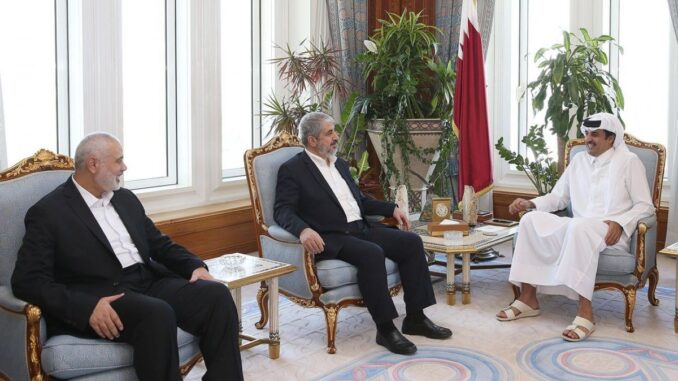
In a significant shift in its foreign policy, Qatar has agreed to expel key leaders of the Hamas political wing from its capital, Doha, following a formal request from the United States. The move comes amid rising international pressure on Qatar to distance itself from Hamas, which is classified as a terrorist organization by the U.S. and several other countries.
This decision marks a notable step in Qatar’s efforts to balance its complex diplomatic relations with various regional powers, particularly the U.S., which has been increasing its pressure on nations that maintain ties with Hamas in light of the ongoing Israel-Hamas conflict.
U.S. Request for Action
The United States had been calling on Qatar for months to expel senior Hamas leaders, particularly after the outbreak of violence between Israel and Hamas in October 2023, which escalated the long-standing Israeli-Palestinian conflict. U.S. officials expressed concerns that Qatar’s hosting of Hamas leaders in Doha could potentially complicate peace efforts and provide a platform for the group to coordinate its military and political activities.
While Qatar had long maintained that it hosted Hamas representatives to facilitate dialogue with Palestinian factions and to advocate for a political solution to the Israeli-Palestinian conflict, the U.S. pressure mounted as part of a broader push to isolate groups linked to violence in the region.
Qatar’s Shift in Policy
Qatar’s decision to expel Hamas leaders from Doha came after diplomatic discussions between senior Qatari officials and U.S. representatives. The agreement appears to be part of a broader effort by Qatar to demonstrate its commitment to regional stability and to bolster its relationship with the United States.
Qatari officials, while announcing the decision, emphasized their continued support for Palestinian self-determination and humanitarian aid efforts in Gaza. However, they also acknowledged that their decision to expel Hamas leaders was made in response to international concerns over the group’s activities.
“We remain committed to supporting the Palestinian people in their quest for justice and peace,” said a senior Qatari diplomat, “but we have agreed to make this decision in the interest of regional peace and in alignment with our efforts to maintain strong ties with our international partners.”
Impact on Hamas and Regional Politics
The expulsion of Hamas leaders from Doha is expected to have significant implications for the group’s operations, though its exact impact remains uncertain. Hamas has relied on Qatar as a major source of financial and diplomatic support, and the removal of its senior leaders from the country could disrupt some of the group’s operations, especially in terms of political outreach and fundraising.
However, Hamas is likely to continue its activities in other regions, particularly in Turkey and Lebanon, where it has established a presence. In fact, the decision by Qatar could push Hamas to further solidify its relationships with other regional powers that have been more sympathetic to its cause, including Iran, which has long provided support to the group.
For Qatar, the expulsion represents a delicate diplomatic balancing act. While it has complied with the U.S. request, the country also risks alienating parts of the Arab world, including Turkey and Iran, who have more lenient views on Hamas. Qatar’s role in the Gulf Cooperation Council (GCC) and its close ties with key players like Saudi Arabia and the United Arab Emirates will likely come under scrutiny, especially given the historical tensions over Qatar’s independent foreign policy.
A Broader Diplomatic Context
Qatar’s decision to expel Hamas leaders is not just a one-off event, but rather part of a larger trend of evolving diplomatic dynamics in the Middle East. As the region continues to grapple with the fallout from conflicts like the ongoing Syrian Civil War, the Yemen conflict, and the Israeli-Palestinian situation, many countries in the Gulf have been rethinking their alliances and foreign policies.
Qatar, which has often positioned itself as a mediator and neutral party in regional disputes, has increasingly found itself walking a tightrope between competing geopolitical interests. The U.S., as a key strategic ally of Qatar, has been vocal in its efforts to encourage Arab nations to isolate groups like Hamas and Hezbollah, which the U.S. designates as terrorist organizations.
Conclusion
Qatar’s decision to expel Hamas leaders from Doha, following a request from the United States, represents a significant shift in the Gulf state’s foreign policy and its approach to regional diplomacy. While the move is likely to help repair and strengthen ties with the U.S., it also highlights the complexities of Middle Eastern politics, where alliances and policies often shift in response to evolving pressures. The expulsion of Hamas leaders will have lasting consequences for the group’s operations, but the broader geopolitical ramifications remain to be seen as Qatar continues to navigate the delicate balance between supporting Palestinian rights and maintaining its international relationships.