
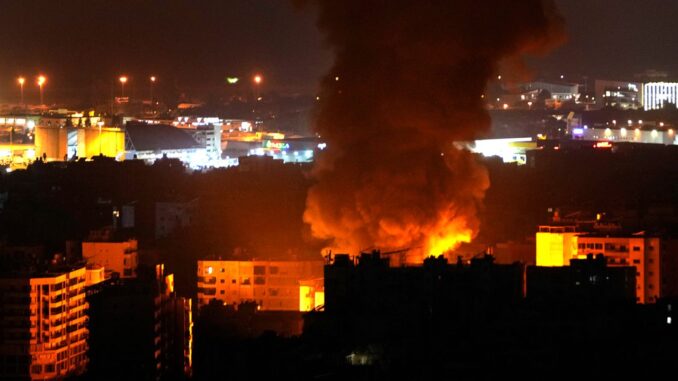
In a significant escalation of the ongoing conflict in Lebanon, the Air Force launched a series of airstrikes on Hezbollah’s stronghold in the southern suburbs of Beirut. The strikes, aimed at dismantling key military infrastructure and supply lines of the Iran-backed militant group, came after Lebanese civilians were told to evacuate the area. The strikes have intensified concerns about the widening regional implications of the conflict.
The Airstrikes and Hezbollah’s Stronghold
The southern suburbs of Beirut, often referred to as “Dahieh,” have long been a Hezbollah stronghold, serving as a hub for the group’s political, military, and social activities. The densely populated area is home to key Hezbollah infrastructure, including command centers, storage facilities, and weapons depots.
Following days of escalating tensions, civilians were urged to evacuate the area as the Air Force began to target Hezbollah positions. Initial reports indicate that multiple buildings, believed to house Hezbollah operatives and weapons caches, were hit in precision strikes. The air raids were aimed at crippling Hezbollah’s military capabilities, especially in response to rocket fire and border skirmishes.
The decision to strike comes amid growing concern that Hezbollah could expand its military activities beyond Lebanon’s borders, potentially drawing neighboring countries deeper into the conflict.
Civilian Evacuations and Humanitarian Concerns
The pre-strike evacuation orders for civilians reflect the complexity of the military operation in Beirut, where Hezbollah operates within densely populated urban areas. The group has been known to position its military assets near civilian infrastructure, making airstrikes particularly risky.
Human rights organizations and humanitarian agencies have expressed concern about the safety of civilians in the region. Despite evacuation warnings, many residents have struggled to flee due to limited access to transportation or fear of leaving their homes. The potential for significant civilian casualties remains a pressing issue, as the strikes target areas embedded within residential neighborhoods.
“The situation on the ground is extremely precarious for civilians,” said a spokesperson from a local humanitarian organization. “While efforts are being made to avoid civilian casualties, the dense nature of the area makes it difficult to fully protect non-combatants.”
Hezbollah’s Response
In the wake of the airstrikes, Hezbollah has vowed to retaliate, further escalating tensions in the region. The group, which has maintained a powerful military presence in Lebanon for decades, has accused its enemies of seeking to destabilize the country and provoke a broader regional conflict.
Hezbollah has historically responded to military strikes with rocket attacks and guerrilla warfare tactics, often targeting border areas or key infrastructure in neighboring countries. The group’s response to the latest airstrikes is expected to be swift and could involve an increase in rocket fire into Israel or attacks on military installations along the border.
The heightened military action also risks drawing Hezbollah’s ally, Iran, into the conflict more directly, raising fears of a broader war that could engulf the Middle East.
Regional Implications and International Reactions
The airstrikes on Hezbollah’s Beirut stronghold come amid rising concerns that the conflict could spiral into a larger regional confrontation. Hezbollah’s close ties to Iran and its involvement in various regional conflicts have long made Lebanon a flashpoint in Middle Eastern geopolitics.
Neighboring countries, particularly Israel, have expressed concern over Hezbollah’s growing arsenal of rockets and advanced weaponry, much of which is believed to be supplied by Iran. Israel has consistently warned that it will not tolerate Hezbollah’s military buildup near its borders, leading to periodic clashes and airstrikes targeting Hezbollah positions in Lebanon and Syria.
International reactions to the airstrikes have been mixed. Western countries have called for restraint, urging both sides to avoid further escalation and ensure the protection of civilians. The United Nations has also called for an immediate ceasefire and has offered to mediate talks between the parties to de-escalate the situation.
Conclusion: A Widening Conflict
The airstrikes on Hezbollah’s stronghold in Beirut represent a significant escalation in the conflict and could mark the beginning of a more intense phase of military operations. With Hezbollah vowing retaliation and civilians caught in the crossfire, the risk of a broader regional war is becoming increasingly apparent.
As the situation continues to evolve, the international community will need to navigate the delicate balance between supporting military efforts to contain Hezbollah and addressing the growing humanitarian crisis in Lebanon. The path ahead remains uncertain, with the potential for further violence looming over a region already fraught with tension.