
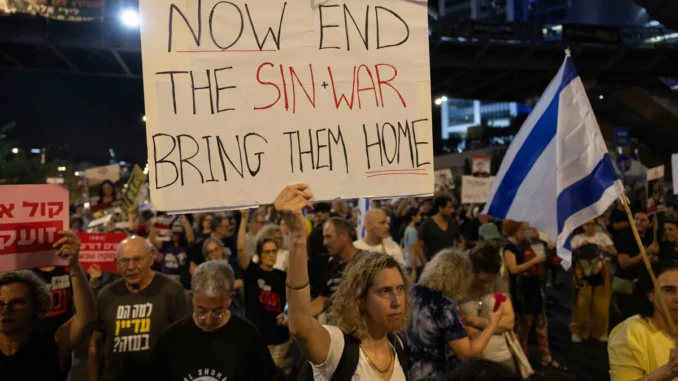
In the wake of Yahya Sinwar’s death, weekly protests have erupted across various Palestinian territories, with demonstrators calling on the Israeli government to leverage the situation to negotiate a hostage deal. Sinwar, the leader of Hamas in Gaza, was killed in recent conflict, and many see this moment as a critical opportunity to secure the release of prisoners held by Israel in exchange for hostages taken during previous clashes.
The Protests: A Call for Action
Each week, demonstrators gather in significant numbers in cities like Gaza City, Ramallah, and other Palestinian areas, expressing their demands for the Israeli government to act decisively in the wake of Sinwar’s death. Protesters carry banners, chant slogans, and hold vigils for those who remain imprisoned or missing, emphasizing the urgency of the situation.
The protests have drawn participation from a wide range of groups, including families of hostages, activists, and political leaders. Many protesters argue that the death of a prominent Hamas leader should serve as leverage for negotiations aimed at securing the release of Israeli hostages held by Hamas and other militant groups.
The Context: Sinwar’s Role and the Hostage Situation
Yahya Sinwar was a controversial figure, known for his strong stance on armed resistance against Israel. His leadership in Hamas was marked by significant military actions, including the 2021 conflict with Israel, which saw widespread violence and loss of life. While his death is viewed as a significant blow to Hamas, many Palestinians believe it also represents an opportunity for progress in negotiations concerning hostages.
The issue of hostages is a deeply emotional and complex matter for both Israelis and Palestinians. For families of hostages, the uncertainty surrounding their loved ones’ fates adds to the anguish of an already difficult situation. On the Palestinian side, many families have long campaigned for the release of prisoners held by Israel, viewing their plight as intertwined with the broader struggle for Palestinian rights and dignity.
Demands for Negotiations
Protesters are vocal in their demands for the Israeli government to take advantage of the current moment to initiate negotiations for a prisoner exchange. Many believe that the international community should also play a role in facilitating talks, given the complexities and sensitivities involved in the situation.
“Sinwar’s death presents a critical juncture for negotiations,” stated a protest leader during a recent demonstration. “We urge the Israeli government to prioritize the lives of hostages and make a serious effort to reach a deal that could bring them home.”
The calls for negotiations are echoed by various political factions within Palestinian society, who see a potential shift in dynamics following Sinwar’s death. The sentiment is that the current climate could provide an opening for dialogue that has long been stymied by political divisions and violence.
The Israeli Response
The Israeli government has remained cautious in its approach to the situation. Officials have expressed their commitment to protecting the lives of hostages and addressing security concerns but have been less forthcoming about specific negotiations in the wake of Sinwar’s killing.
While some analysts argue that leveraging Sinwar’s death could enhance Israel’s bargaining position, others caution against the potential repercussions of engaging with Hamas, a group it considers a terrorist organization. The complexity of the conflict means that any negotiations would be fraught with challenges, and the Israeli government faces internal pressures regarding how to approach the situation.
Broader Implications
The weekly protests highlight the broader implications of Sinwar’s death and the ongoing conflict between Israel and Hamas. As tensions remain high, both sides face significant pressures from their respective populations, with many calling for decisive action and resolution.
For Palestinians, the protests serve as a platform for raising awareness about the plight of hostages and prisoners, while also emphasizing the urgent need for a political solution to the Israeli-Palestinian conflict. The hope is that through sustained advocacy and mobilization, the voices of those affected by the conflict will resonate more widely, pushing for change.
Conclusion: A Critical Moment for Negotiation
The ongoing weekly protests demanding that Israel leverage Sinwar’s killing for a hostage deal underscore the complexities of the Israeli-Palestinian conflict. As demonstrators continue to voice their demands, the situation presents a critical moment for both sides to consider the human cost of continued violence and the potential for negotiation.
While the road to a successful resolution is fraught with challenges, the urgency of the demands from protesters emphasizes the need for dialogue, understanding, and compassion amid a protracted conflict. The international community, along with both Israeli and Palestinian leadership, must take heed of the calls for action and work toward a sustainable solution that prioritizes the lives and dignity of all involved.