
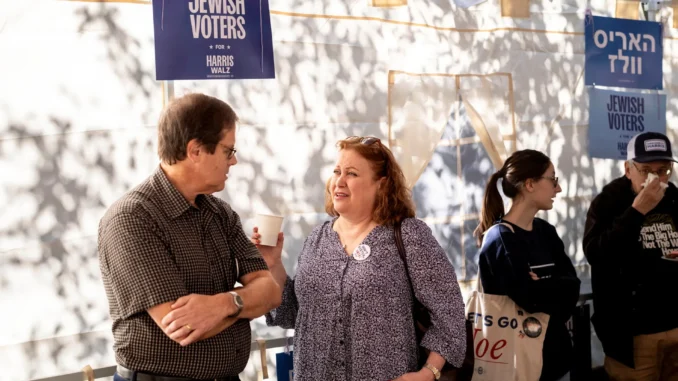
As the United States approaches the 2024 presidential election, attention is turning to a key group that could play a decisive role: Jewish voters in critical battleground states. With Democratic nominee Kamala Harris and Republican contender Donald Trump locked in a fierce contest, Jewish Americans in swing states may have an outsized influence on the election’s outcome. Their vote, concentrated in specific regions, could tilt the scales in a close race and potentially determine the country’s political future for the next four years.
Why Jewish Voters Are Crucial in the 2024 Election
The Jewish American population, while relatively small—around 2% of the total U.S. population—is often well-represented in certain battleground states that hold significant sway in the Electoral College. Many Jewish voters have traditionally leaned Democratic, but recent shifts in political dynamics, foreign policy stances, and issues around religious freedom, antisemitism, and social justice have brought a growing complexity to the group’s political alignment. Harris and Trump have taken sharply different approaches to topics that resonate with Jewish voters, from U.S.-Israel relations to domestic policies on religious freedom and combating hate crimes.
According to recent surveys, Jewish voters are concentrated in the following seven battleground states, where their votes could prove pivotal: Pennsylvania, Florida, Arizona, Michigan, Wisconsin, Georgia, and Nevada. These states are expected to be closely contested, and their electoral votes could determine the election outcome.
Key Issues Shaping the Jewish Vote
- U.S.-Israel Relations
Traditionally, support for Israel has been a significant factor for many Jewish voters. Trump’s administration was known for its pro-Israel policies, including moving the U.S. Embassy to Jerusalem and brokering the Abraham Accords, which normalized relations between Israel and several Arab nations. Harris has reaffirmed her commitment to Israel’s security but emphasizes a two-state solution and a more diplomatic approach. For some Jewish voters, Trump’s past policies represent a stronger commitment to Israel, while others appreciate Harris’s nuanced stance on peace and humanitarian concerns in the region. - Rising Antisemitism and Hate Crimes
Antisemitic incidents have increased in recent years, with Jewish communities across the U.S. expressing concerns about safety and governmental response. Both Harris and Trump have condemned antisemitism, but they differ in their approaches. Harris has pushed for stronger hate crime legislation and has supported increased funding for security at religious institutions. Trump, on the other hand, has emphasized free speech protections while supporting existing hate crime initiatives. Jewish voters concerned about antisemitism may be influenced by these contrasting stances. - Religious Freedom and Church-State Separation
Religious freedom remains a high-priority issue for Jewish Americans, particularly concerning the separation of church and state. Trump’s administration focused on increasing religious expressions in public spaces, a move welcomed by some conservative Jewish groups but criticized by others who favor a strict separation. Harris advocates for policies that prevent religious beliefs from infringing on public policy, which resonates with Jewish Americans concerned about maintaining secular governance. - Social Justice and Civil Rights
Many Jewish voters are drawn to issues around civil rights, social justice, and economic inequality. Harris’s platform on progressive social reforms, including healthcare, education, and criminal justice reform, aligns with values held by a substantial portion of Jewish Americans. Trump, conversely, has focused on economic freedom and deregulation, which appeals to Jewish business owners and those concerned about government overreach. The divergence between candidates on these issues could sway Jewish votes in key regions.
Jewish Voting Power in Swing States
- Pennsylvania and Florida:
Pennsylvania, with a significant Jewish population in cities like Philadelphia, and Florida, particularly in South Florida, are two states where Jewish voters have substantial influence. Florida’s Jewish community has leaned Democratic historically, but shifts have been noted among conservative Jewish voters, who favor Trump’s stance on Israel and national security. - Arizona and Nevada:
The Jewish communities in Arizona and Nevada are growing and have shown fluctuating political leanings in recent elections. In a close race, Jewish voters in these states, who may prioritize issues like healthcare and economic policy, could help decide the outcome. - Michigan and Wisconsin:
Jewish voters in the Midwest, particularly in Michigan and Wisconsin, have a strong presence in urban areas. In 2020, their support for Democratic candidates was crucial, and Harris’s campaign hopes to maintain this support. Trump, however, has worked to appeal to these voters by emphasizing economic growth and strong U.S.-Israel relations. - Georgia:
Georgia’s Jewish community has been politically active, particularly in the Atlanta metropolitan area. With the state having shifted to the Democrats in 2020, both parties are focusing on this group to maintain or flip the state. Jewish voters in Georgia are expected to weigh in on issues like civil rights, healthcare, and antisemitism policies.
Final Thoughts
Jewish voters in these battleground states are likely to be pivotal in the 2024 election, as they weigh issues ranging from international relations to domestic social policies. As both campaigns ramp up outreach efforts, the Jewish vote could prove decisive in states where margins are razor-thin. For Harris, the challenge lies in retaining a traditionally Democratic demographic amid growing concerns over Israel policy and rising antisemitism. For Trump, the focus will be on energizing conservative-leaning Jewish voters who align with his pro-Israel stance and emphasis on religious freedom.
The significance of Jewish voters in this election highlights how specific demographic groups in critical areas can shape the course of U.S. politics. Both parties are watching closely, as a shift in these key states could ultimately tip the balance and decide the presidency.